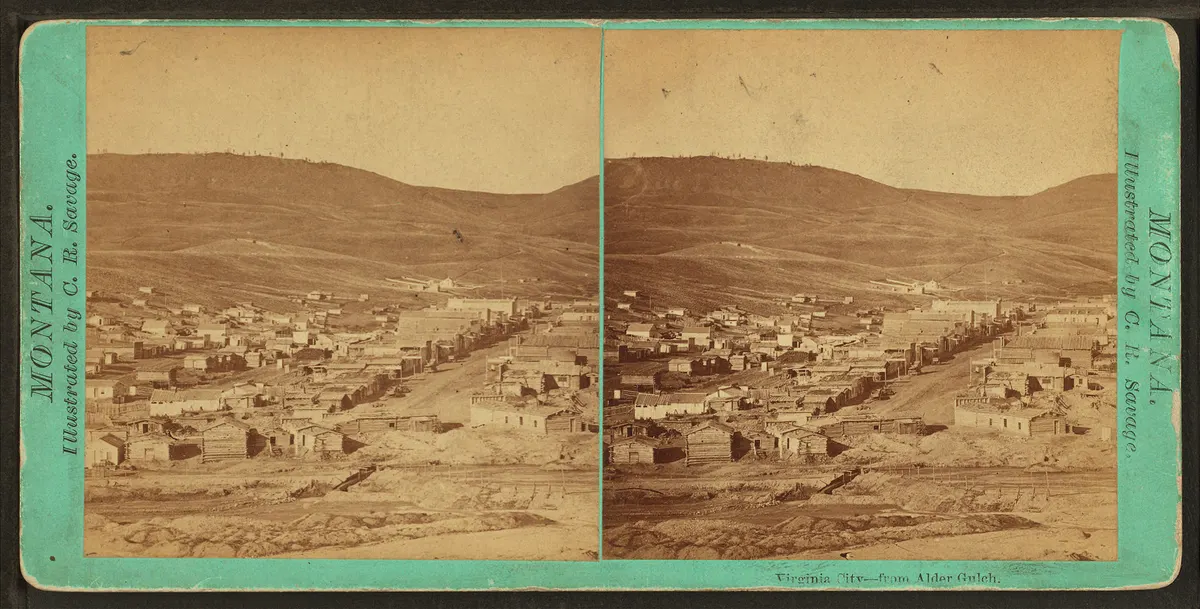
Montana Gold Rush
The Rocky Mountain West, 1862–1869
Date range
1862 – 1869
Key Towns
Bannack, Virginia City, Nevada City, Helena (Last Chance Gulch), Deer Lodge
Trigger Event
On July 28, 1862, John White and a party of Pike’s Peak veterans discovered gold in the gravel bars of Grasshopper Creek in the Beaverhead Mountains, establishing Bannack as Montana’s first mining town. In May 1863, Henry Edgar, Bill Fairweather, and four partners found gold in Alder Gulch — 45 miles northeast of Bannack — in what proved to be the largest gold strike in Montana’s history.
Gold Recovered
Grasshopper Creek: ~$5 million; Alder Gulch: largest Montana strike; Montana placer mines produced $90+ million (1862–1866); Last Chance Gulch (Helena) produced $19+ million. Grasshopper Creek gold was 99–99.5% pure.
Peak Population
Bannack: 3,000+ by 1863; Alder Gulch: 10,000 at peak along ‘Fourteen-Mile City’; Virginia City and Nevada City combined: thousands
Map: Montana Gold Rush (45.16, -112.99)
The Montana Gold Rush was not a single event but a series of cascading strikes between 1862 and the early 1870s, each drawing more prospectors northward and deeper into the Rocky Mountain wilderness, collectively transforming a region of Indigenous treaty lands into the Territory of Montana. Beginning at Grasshopper Creek in 1862 and culminating in the discovery at Last Chance Gulch in 1864, the Montana rush produced some of the purest gold ever found in North America and established the foundations of several of the state’s most important cities.
The opening strike came on July 28, 1862, when John White and a party of prospectors — veterans of Colorado’s Pike’s Peak rush — discovered gold in the gravel bars of Grasshopper Creek in the Beaverhead Mountains. Bannack, established at the site, became Montana’s first significant mining town and, briefly, the first territorial capital. The Grasshopper Creek gold was exceptional in its purity — assaying at 99 to 99.5% fineness, compared to the 95% average of most North American placer gold — which generated immediate excitement and drew new parties northward from Idaho.
The following year, 1863, brought the discovery that would dwarf even Grasshopper Creek. In May, a six-man party — Henry Edgar, Bill Fairweather, Henry Rodgers, Barney Hughes, Thomas Cover, and Bill Sweeney — found gold in a dry gulch 45 miles northeast of Bannack. Alder Gulch proved to be the largest of all Montana’s gold strikes. The chain of camps that sprang up along its fourteen-mile length — collectively called ‘Fourteen-Mile City’ — coalesced into Virginia City and Nevada City. At the rush’s height, an estimated 10,000 people were living along the gulch, an extraordinary concentration in a location that had been empty wilderness just months before.
Montana’s rush was also marked by extraordinary violence. The absence of established law enforcement created conditions in which organized crime thrived. A gang led by Henry Plummer — who simultaneously served as elected sheriff of Bannack — terrorized the mining camps, robbing and murdering travelers. The Vigilantes of Montana, a committee of miners and merchants formed in the winter of 1863–64, hanged more than 20 men, including Plummer himself, in a decisive extrajudicial campaign that broke the gang and established a rough order. Wilbur Fisk Sanders, a prominent lawyer and later U.S. Senator, played a key role in prosecuting gang members before the vigilante committee.
In July 1864, four Georgia-born prospectors discovered gold in Last Chance Gulch, giving rise to Helena, the eventual state capital. Within four years of the 1862 opening strike, Montana’s placer mines had produced more than $90 million in gold — approximately $1.1 billion in today’s terms. Montana Territory was formally established in May 1864, just 14 months after the Alder Gulch discovery, reflecting the speed with which gold rush communities organized into governance structures in the American West.
Timeline
Gold rush begins
Rush concludes / mining activity winds down
Notable Figures
John White
Notable FigureJohn White was a prospector among the Colorado "Pikes Peakers" who on July 28, 1862, discovered gold on Grasshopper Creek in present-day Montana — the strike that created Bannack, first capital of Montana Territory, and opened the Montana gold rushes.
Henry Edgar
Notable FigureHenry Edgar was a prospector who, with Bill Fairweather, discovered gold at Alder Gulch, Montana, on May 26, 1863 — one of the richest placer strikes in history, birthplace of Virginia City. His diary became a key record of the find; he ranched in Montana until his death in 1910.
Bill Fairweather
Notable FigureBill Fairweather was a prospector who co-discovered the fabulously rich Alder Gulch placers in Montana on May 26, 1863, giving rise to Virginia City. Famous for his reckless generosity — he reportedly scattered gold dust in the streets — he died broke in 1875.
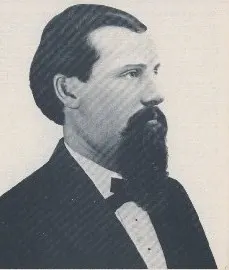
Henry Plummer
Notable FigureHenry Plummer was an American lawman and convicted killer who became sheriff of the gold camp of Bannack, Montana, in 1863. Accused of secretly leading a gang of road agents, he was hanged without trial by vigilantes in January 1864; his guilt is still debated.
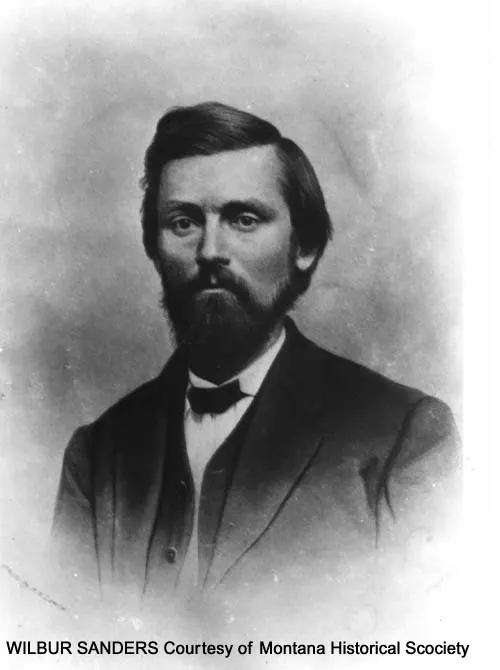
Wilbur Fisk Sanders
Notable FigureWilbur Fisk Sanders was a lawyer who prosecuted road agent George Ives in 1863 and helped found the Montana Vigilantes during the Alder Gulch gold rush. A founder of the Montana Historical Society, he later served as one of Montana's first U.S. senators.
Gold on Grasshopper Creek in 1862 created Bannack, and the 1863 strike in Alder Gulch built Virginia City, briefly the biggest settlement in the northern Rockies — together they pulled tens of thousands into what became Montana Territory in 1864, with Bannack its first capital. The era is infamous for its road agents and the Montana Vigilantes, who hanged Sheriff Henry Plummer and two dozen others. The rushes accelerated the invasion of Shoshone, Bannock, and other Indigenous homelands and fed the traffic on the Bozeman Trail that ignited war on the northern plains.
Few places preserve this era better. Bannack is now a state park ghost town of some sixty original buildings, while Virginia City and Nevada City survive as remarkably intact boardwalk towns where heritage tourism, summer theatre, and living history sustain the community. Dredge tailings still corrugate Alder Gulch, testimony to the tens of millions in gold the district produced.