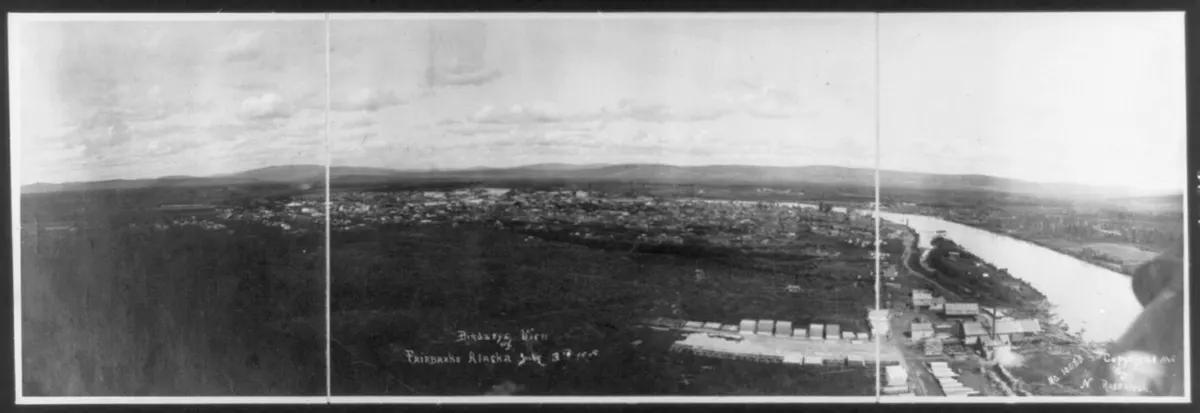
Fairbanks Gold Rush
The Yukon and Alaska, 1902–1905
Date range
1902 – 1905
Key Towns
Fairbanks, Chena
Trigger Event
Felix Pedro, an Italian prospector, discovers gold-bearing creeks near the Chena River on July 22, 1902, leading to the founding of Fairbanks
Gold Recovered
Estimated 15.4 million troy ounces total from the Fairbanks district over its productive life; one of the richest placer districts in Alaska
Peak Population
Approximately 10,000 by 1905; Fairbanks became Alaska’s largest city
Map: Fairbanks Gold Rush (64.83, -147.90)
The Fairbanks Gold Rush of 1902–1905 transformed the interior of Alaska and gave rise to what would become the state’s second-largest city, a metropolis of the subarctic that endured long after the gold had played out and continues to serve as a vital regional center today. Unlike the coastal rushes at Nome or the accessible terrain of the Klondike, the Fairbanks district sat deep in the Alaskan interior, hundreds of miles from the nearest port, in a landscape of boreal forest, permafrost, and rivers that froze solid for six months of the year. That Fairbanks flourished despite these conditions is a testament both to the richness of its gold deposits and to the character of the men and women who built it.
The discovery that sparked the rush was made on July 22, 1902, by Felix Pedro, an Italian immigrant whose given name was Felice Pedroni. Pedro had been prospecting the creek drainages of interior Alaska for several years, working with characteristic persistence through difficult terrain. On that summer day, he found gold-bearing gravel on a tributary of the Chena River, a stream he named Pedro Creek in honor of the occasion. Pedro’s find was not immediately spectacular — it took some time for the richness of the district to become apparent — but it was sufficient to attract other prospectors to the area.
Crucial to the development of Fairbanks was the presence of Elbridge Truman Barnette, a trader and entrepreneur who had been attempting to establish a trading post as far up the Tanana River as possible. When his steamboat, the Isabelle, was stopped by low water on the Chena River at a point far short of his intended destination in August 1901, Barnette was forced to unload his supplies on the riverbank. This apparently disastrous turn of events proved fortuitous: Barnette’s cache of goods was precisely where Pedro and other prospectors needed supplies, and the trading post he established at that spot became the nucleus of Fairbanks. Barnette named the camp after Senator Charles Fairbanks of Indiana, hoping to curry political favor that might help him obtain a license for a town site.
The rush developed rapidly through 1903 and 1904 as the richness of the surrounding creek drainages became clear. Pedro Creek, Cleary Creek, Ester Creek, Goldstream Creek, and many other tributaries of the Chena and Tanana proved to carry payable gold in their gravels, and the creek-claim system was quickly established across the district. Dawson City veterans, Nome miners, and newcomers from the Pacific states all flocked to Fairbanks, and the town grew from a supply cache to a substantial community with remarkable speed.
The gold at Fairbanks was largely placer gold locked in deep creek gravels and in the bedrock beneath them, overlain by permafrost that complicated but also, paradoxically, aided mining. The frozen ground preserved the gravels and prevented them from being washed away, and miners learned to use steam thawing — driving steam pipes into the frozen ground to melt the permafrost — to access the richest pay streaks lying on bedrock. This technology, developed and refined in the Fairbanks district, became standard throughout Alaskan placer mining.
By 1905, Fairbanks had a population of approximately 10,000 people and had grown into Alaska’s largest city. It had newspapers, hospitals, churches, schools, banks, and a surprisingly sophisticated infrastructure for a community of its age and location. The construction of the Tanana Valley Railroad, connecting Fairbanks to the surrounding mining creeks, improved the movement of men, equipment, and supplies. Later, the Alaska Railroad extended a connection to Fairbanks from Seward on the coast, integrating the interior city with the broader Alaskan economy.
The Fairbanks district’s gold production was extraordinary in its scale and longevity. Unlike many rushes that flared brightly and quickly exhausted themselves, Fairbanks sustained significant production for decades. Dredges — the massive floating machines that could process enormous volumes of gravel — were introduced to the district in the early twentieth century and continued operating through the mid-century and beyond. Total production from the Fairbanks district is estimated at approximately 15.4 million troy ounces, a figure that places it among the most productive placer districts in Alaskan and North American history.
Fairbanks survived the decline of placer gold, reinventing itself as a military hub during World War II and the Cold War, a trans-Alaska pipeline terminus city in the 1970s, and a regional center for interior Alaska. Felix Pedro’s discovery on a summer day in 1902 set in motion a chain of events that shaped the entire interior of Alaska, leaving a city in the wilderness that endures as testimony to what the pursuit of gold can build.
Timeline
Gold rush begins
Rush concludes / mining activity winds down
Notable Figures
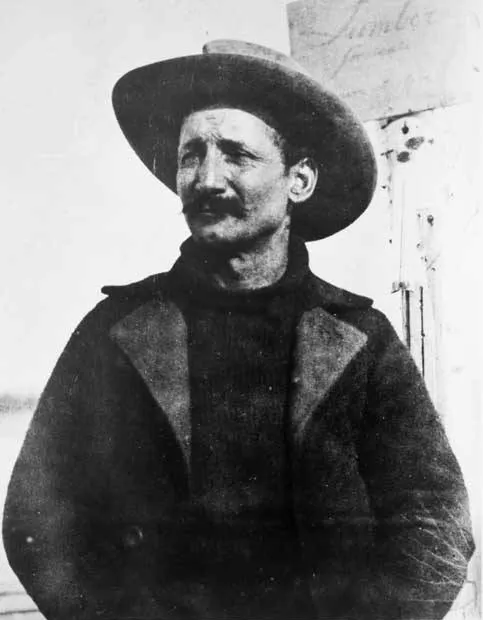
Felix Pedro
Notable FigureFelix Pedro, born Felice Pedroni in Italy, was the prospector whose July 1902 gold strike on a creek north of the Chena River touched off the Fairbanks Gold Rush and turned E.T. Barnette's stranded trading post into Alaska's interior metropolis.
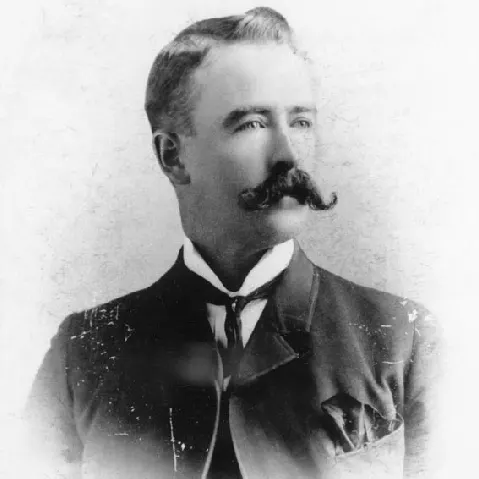
E.T. Barnette
Notable FigureE.T. Barnette was a riverboat trader whose supplies were put ashore on the Chena River in 1901 when his steamer could go no farther. Felix Pedro's 1902 gold strike turned the stranded trading post into Fairbanks, and Barnette became the city's first mayor.
Felix Pedro's July 1902 strike in the Tanana hills, paired with trader E.T. Barnette's opportunistically placed trading post, created Fairbanks and pulled thousands of miners north from the fading Klondike and Nome rushes. Unlike most stampede camps, Fairbanks matured into the permanent hub of interior Alaska: deep placer gravels sustained decades of work, giant dredges churned the creeks into the 1960s, and the town became the terminus of the Alaska Railroad and home of the university. The rush transformed the lands of the Tanana Dene (Athabascan) peoples, who supplied wood, meat, and labor to the camps while facing disease and displacement from traditional sites.
Gold still matters here — the Fort Knox mine northeast of town is among Alaska's largest producers. Visitors pan paydirt at Gold Dredge 8, a National Historic District, visit the Felix Pedro monument on the Steese Highway, and explore interior mining history at the University of Alaska's Museum of the North and Pioneer Park.