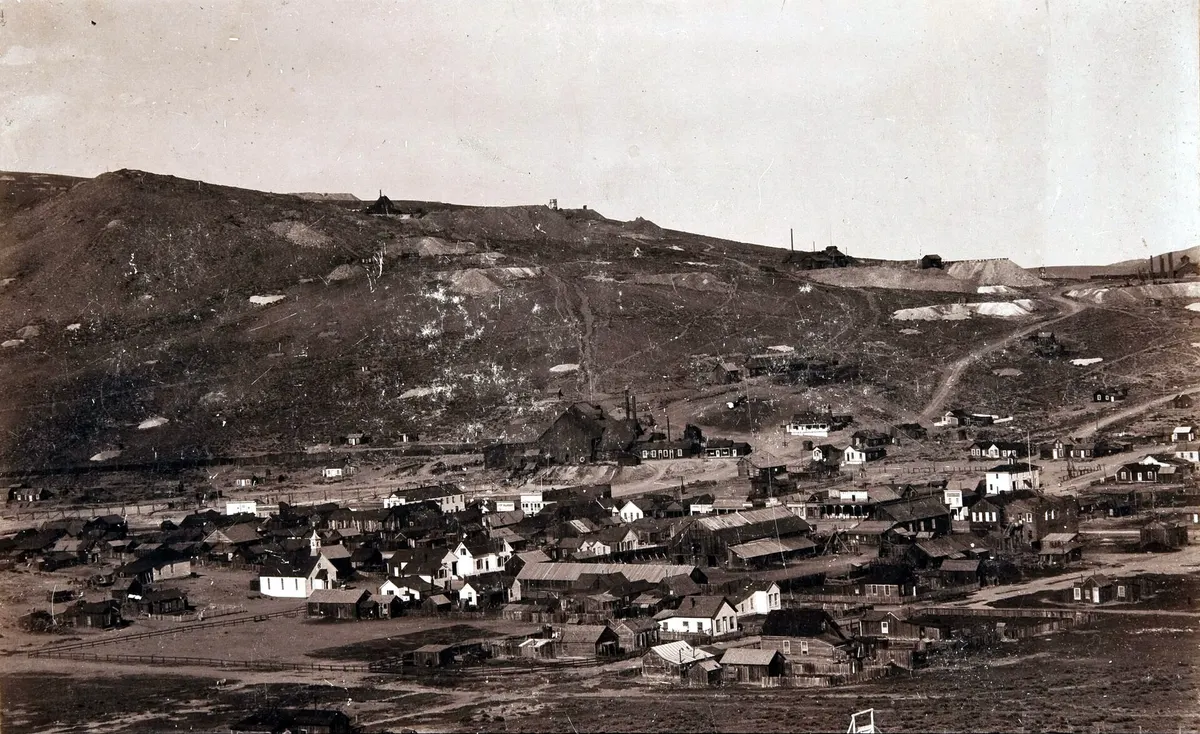
Bodie Gold Rush
California, 1876–1882 (peak; intermittent mining to 1942)
Date range
1876 – 1942
Key Towns
Bodie (Mono County, Eastern Sierra Nevada, California)
Trigger Event
Although Waterman S. Body first discovered gold near Bodie in 1859, the major rush was triggered in 1876 when the Standard Company discovered a large, profitable ore body. Rich discoveries at the adjacent Bodie Mine in 1878 accelerated growth and transformed a modest camp into one of California’s most notorious boomtowns.
Gold Recovered
Estimated $34 million total (in 1986 dollars; ~$85 million in 2021 dollars); peak production 1879; Standard Mine alone was the district’s primary producer
Peak Population
~10,000 by 1879–80; ~2,000 buildings on Main Street alone; one of the largest cities in California at its peak
Map: Bodie Gold Rush (38.21, -119.01)
The Bodie Gold Rush of 1876–1882 was one of the last great California gold rushes, transforming a forgotten mining camp on the high eastern sierras of Mono County into one of the most populated and most violent boomtowns in the American West. Today Bodie is preserved as a California State Historic Park and is considered one of the finest examples of an authentic gold rush ghost town in the country.
Gold was first discovered near Bodie in 1859 by Waterman S. Body, a prospector who gave his name to the future town — through a spelling error that stuck. Body died in a snowstorm during the winter of 1859–60 on a supply trip, never living to see what his discovery would become. The Bodie Mining District was organized in 1860, but the initial finds were modest and the area attracted only a small population through the 1860s and early 1870s.
The true rush began in 1876, when the Standard Company discovered a substantial and profitable ore body that transformed the economics of the district. Rich strikes at the adjacent Bodie Mine in 1878 added further momentum, and the population exploded from a few dozen residents in 1876 to an estimated 10,000 by 1879 and 1880. At its peak, Bodie had approximately 2,000 buildings, a Main Street more than a mile long, a Chinese quarter on the northwestern edge of town, churches, schools, a jail, and dozens of saloons and gambling establishments. It was one of the largest cities in California.
Bodie developed a reputation for violence and lawlessness that was not entirely undeserved, though it was also amplified by the press. Shootings, robberies, and bar fights were frequent enough to give the town a national reputation, and the local newspaper kept careful track of the mortality rate with a category labeled ‘Bad Men of Bodie.’ The camps also attracted a large Chinese immigrant community, who had come to Bodie from Southern China as contract laborers beginning in 1878 and who established a distinct community on the outskirts of the main town.
Gold and silver production peaked in 1879 and then declined steadily through the early 1880s as the richest ore was extracted and costs rose. By 1882, the population had fallen sharply, and the great rush was over, though intermittent mining continued through the early twentieth century and the district produced a total of approximately $34 million in gold and silver in constant 1986 dollars. Bodie was designated a State Historic Park in 1962 and is maintained in a state of ‘arrested decay,’ preserving its atmospheric ruins as a monument to the California gold rush era.
Timeline
Gold rush begins
Rush concludes / mining activity winds down
Notable Figures
Bodie's boom came late: gold was found in 1859, but it was the Standard Company's 1876 strike that turned a struggling camp into a roaring town of some 7,000–8,000 people by 1879, with dozens of saloons and a reputation as one of the wildest camps in the West. Its mines produced roughly $34 million in gold before decline set in during the 1880s. The rush transformed the high desert east of the Sierra, drawing timber and water infrastructure from miles around and pressing hard on the lands and livelihoods of the Kutzadika'a (Mono Lake) Paiute.
Fires in 1892 and 1932 destroyed much of the town, and the last residents drifted away by the 1940s. In 1962 Bodie became a State Historic Park preserved in "arrested decay," and today it is America's best-known authentic gold-rush ghost town, drawing visitors from around the world to its weathered streets at 8,400 feet.