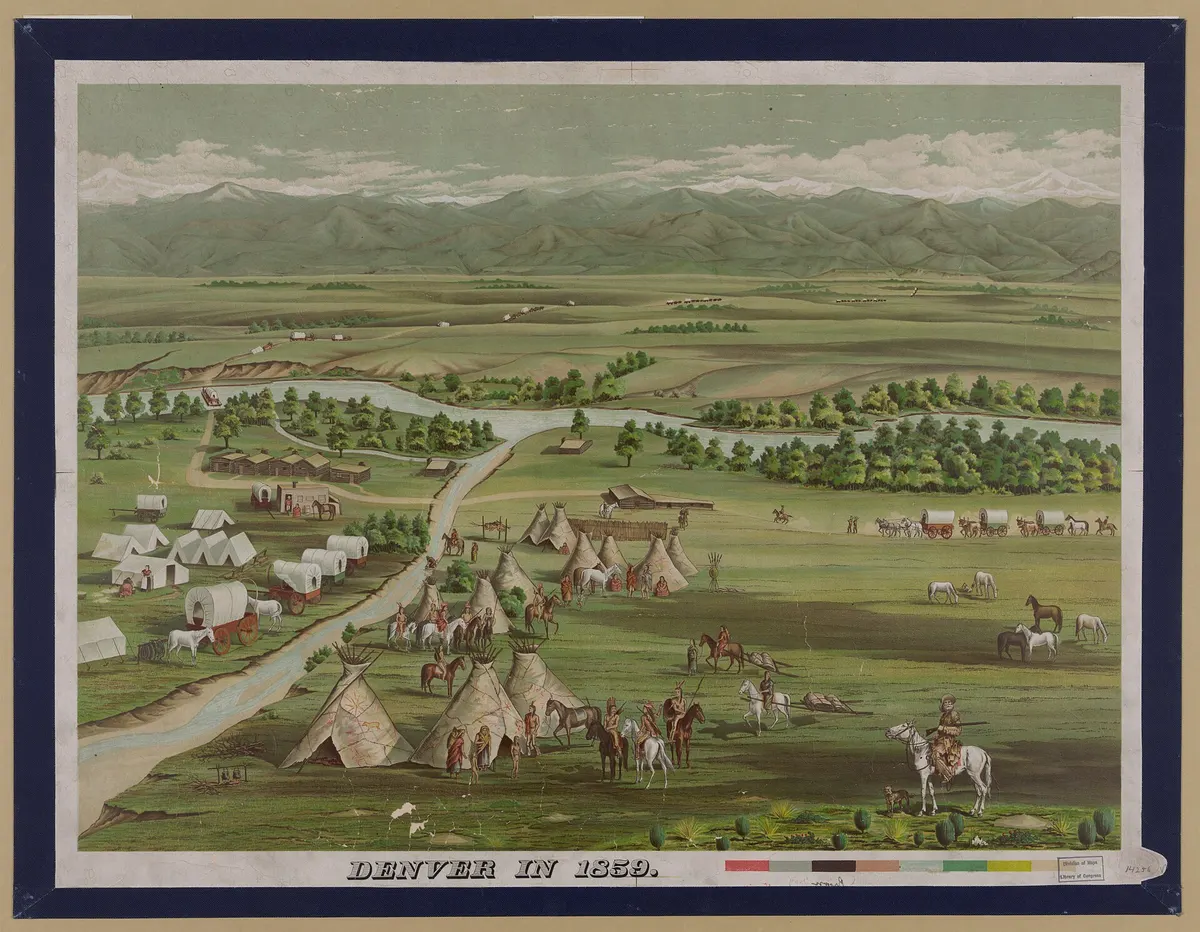
Pike’s Peak Gold Rush
The Rocky Mountain West, 1858–1861
Date range
1858 – 1861
Key Towns
Denver City, Central City, Black Hawk, Idaho Springs, Georgetown, Boulder
Trigger Event
Economic depression following the Panic of 1857 sent desperate prospectors west. Initial modest gold finds on Dry Creek and Cherry Creek in summer 1858 were followed by John Gregory’s discovery of a rich gold-bearing quartz lode in Gregory Gulch in May 1859, triggering a full-scale rush of ~100,000 people toward the Colorado Rockies.
Gold Recovered
150,000 troy ounces in 1861; 225,000 troy ounces in 1862; Central City district alone produced millions over subsequent decades of lode mining
Peak Population
~100,000 set out for the goldfields in 1859; ~40,000 reached Denver; ~25,000 entered the mountains April–October; ~10,000 remained by August 1859
Map: Pike’s Peak Gold Rush (39.74, -104.98)
The Pike’s Peak Gold Rush of 1858–1861 was the defining event in the settlement of what would become the Territory and then State of Colorado, bringing a wave of fortune-seekers to the Rocky Mountains and transforming a sparsely inhabited stretch of Kansas Territory into one of the most rapidly urbanizing regions in North America. Though remembered under the banner of ‘Pike’s Peak or Bust,’ the gold fields that actually drove the rush lay not at Pike’s Peak itself — never a significant mining area — but in the mountains north and west of it, primarily in Clear Creek Canyon and the Gilpin County hills around Central City and Gregory Gulch.
The origins of the rush lay in a convergence of economic distress and western optimism. The financial Panic of 1857 had devastated the eastern and frontier economies, leaving tens of thousands of families without employment or prospects. Into this environment came reports, beginning in the summer of 1858, of gold discoveries in the creeks draining the eastern face of the Colorado Rockies. Initial finds were made by a party that included veterans of the 1828 Georgia gold rush, whose placer experience guided their search of Dry Creek and Cherry Creek near the future site of Denver. Their discoveries were modest enough that the first wave of prospectors who arrived in the fall of 1858 — known as ‘go-backs’ for their discouraged return east — dismissed the reports as exaggeration.
The tide turned decisively in May 1859 when John Gregory, a Georgia-born miner, discovered a rich gold-bearing quartz lode in what would be named Gregory Gulch, in the mountains west of Denver. Gregory’s find was immediately recognized as substantial, and it triggered a second, far larger wave of migration. Possibly as many as 100,000 people set out for the Pike’s Peak goldfields over the course of 1859, though observers estimated only around 40,000 actually reached Denver, with perhaps 25,000 entering the mountains between April and October. Those who arrived found a rapidly expanding cluster of mining camps — Central City, Black Hawk, and Nevada City growing around Gregory Gulch, while George Andrew Jackson’s separate discovery on Clear Creek spawned the camps of Idaho Springs and Georgetown to the south.
Denver, founded as a speculative townsite at the junction of Cherry Creek and the South Platte River in 1858, rapidly became the commercial heart of the entire rush — the gateway through which supplies, people, and capital flowed into the mountains and through which gold was shipped east. William Byers, who launched the Rocky Mountain News on April 23, 1859 — just days before Gregory’s discovery — became the voice of the new territory, promoting its mineral wealth and documenting the chaos of its formation with equal energy.
Colorado produced 150,000 troy ounces of gold in 1861 and 225,000 troy ounces in 1862, and the Central City district — which styled itself ‘the richest square mile on earth’ — sustained productive lode mining long after the initial placer rush had subsided. The shift from placer to hard-rock lode mining required stamp mills, pumping equipment, and engineering expertise that transformed the rough mining camps into something approaching permanent industrial settlements.
The political consequences were profound and rapid. In February 1861, the United States Congress established the Territory of Colorado, carved from Kansas and Nebraska territories specifically to provide governance for the exploding mining population. Statehood followed in 1876, making Colorado the ‘Centennial State.’ The rush created the bones of the urban infrastructure — Denver, Boulder, Colorado Springs — that defines modern Colorado, while dozens of smaller mining camps have faded into the ghost towns that today attract visitors to the high Rockies.
Timeline
Gold rush begins
Rush concludes / mining activity winds down
Notable Figures
John Gregory
Notable FigureJohn H. Gregory was a Georgia prospector whose May 1859 discovery of the first gold lode in the Rocky Mountains, in the gulch above present-day Black Hawk and Central City, proved the Pike's Peak rush real and opened 'the richest square mile on earth.'
George Andrew Jackson
Notable FigureGeorge Andrew Jackson was a Missouri-born prospector whose January 1859 find of placer gold where Chicago Creek meets Clear Creek was the first substantial gold discovery in Colorado, giving rise to Idaho Springs and helping ignite the Pike's Peak rush.
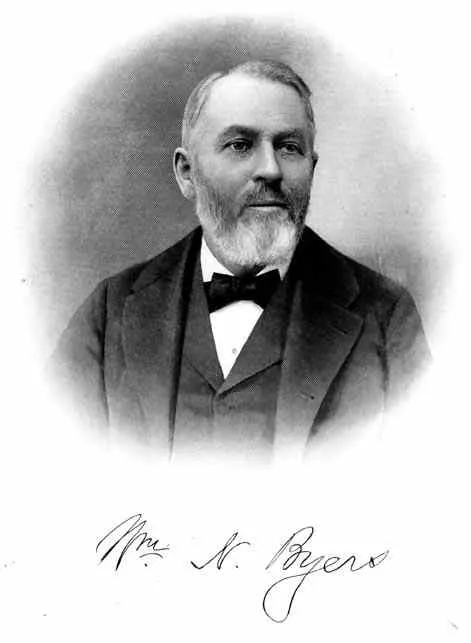
William N. Byers
Notable FigureWilliam N. Byers founded the Rocky Mountain News in 1859, printing Denver's first newspaper within days of arriving, and became the Pike's Peak gold rush's greatest promoter, boosting Colorado settlement for the rest of his life.
"Pike's Peak or Bust" drew perhaps 100,000 fifty-niners across the plains in 1858–59, and the rich strikes by George Jackson and John Gregory in the mountains above Denver turned a speculative stampede into the founding event of Colorado. Denver, Golden, Central City, and Idaho Springs all date from the rush, which led directly to Colorado Territory in 1861. The invasion overran lands guaranteed to the Cheyenne and Arapaho by the 1851 Treaty of Fort Laramie; the pressures it unleashed culminated in the coerced Treaty of Fort Wise and, in 1864, the Sand Creek Massacre — atrocities inseparable from the rush's legacy.
Today the gold-rush corridor is Colorado's heritage spine: Central City and Black Hawk are a National Historic Landmark district, Idaho Springs preserves the Argo Mill and mine tours, and museums from the History Colorado Center in Denver to the Western Museum of Mining & Industry in Colorado Springs interpret the era, while Sand Creek is a National Historic Site of remembrance.