Northern Nevada Gold Rush
The Rocky Mountain West, 1850–1934
Date range
1850 – 1934
Key Towns
Virginia City, Gold Hill, Dayton, Tonopah, Carson City, Reno
Trigger Event
Placer gold discovered by miners in Gold Canyon near present-day Dayton, Nevada, beginning around 1850; activity intensifies dramatically with the 1859 Comstock Lode discovery and persists through successive booms including Tonopah (1900), with a final revival when Roosevelt raises the gold price in 1934
Gold Recovered
The Comstock Lode alone produced over $300 million in combined gold and silver in the 1860s–1880s, including more than 8 million ounces of gold; total northern Nevada output across the full period was in the hundreds of millions of dollars
Peak Population
Virginia City peaked at approximately 25,000 in the early 1870s, making it the most important city between Chicago and San Francisco
Map: Northern Nevada Gold Rush (39.31, -119.65)
The Northern Nevada Gold Rush was not a single event but a long, continuous arc of mineral discovery, exploitation, decline, and revival that unfolded over more than eighty years across the mountains and valleys of the Great Basin. Beginning with modest placer finds in 1850 and concluding with a government-induced revival in 1934, it encompassed the most spectacular silver-and-gold bonanza in American history, the rise and fall of one of the nineteenth century’s great cities, and a succession of smaller booms and busts that shaped Nevada’s character as a mining state unlike any other.
The first chapter began quietly. In 1849, Abner Blackburn made an initial gold discovery in Gold Canyon, a dry ravine draining the eastern slope of the Sierra Nevada near present-day Dayton. In 1850, William Prouse found gold further up the canyon, and within months several hundred miners were working the valley floor, sluicing the canyon gravels for the modest placer gold they contained. The settlement of Dayton grew as a supply point for this first Nevada mining community, and for nearly a decade the canyon produced consistent if unspectacular returns.
The second chapter transformed everything. In June 1859, two Irish prospectors, Peter O’Riley and Pat McLaughlin, encountered what appeared to be a placer deposit on the slope of Mount Davidson above Gold Canyon. Their neighbor Henry Comstock, a loquacious and opportunistic trapper, talked his way into a share of the claim and attached his name to the ore body that lay beneath. Assays of the heavy blue-gray material that had been clogging their sluice boxes revealed that it was extraordinarily rich silver ore — and that it also contained gold in significant quantities. The Comstock Lode had been found.
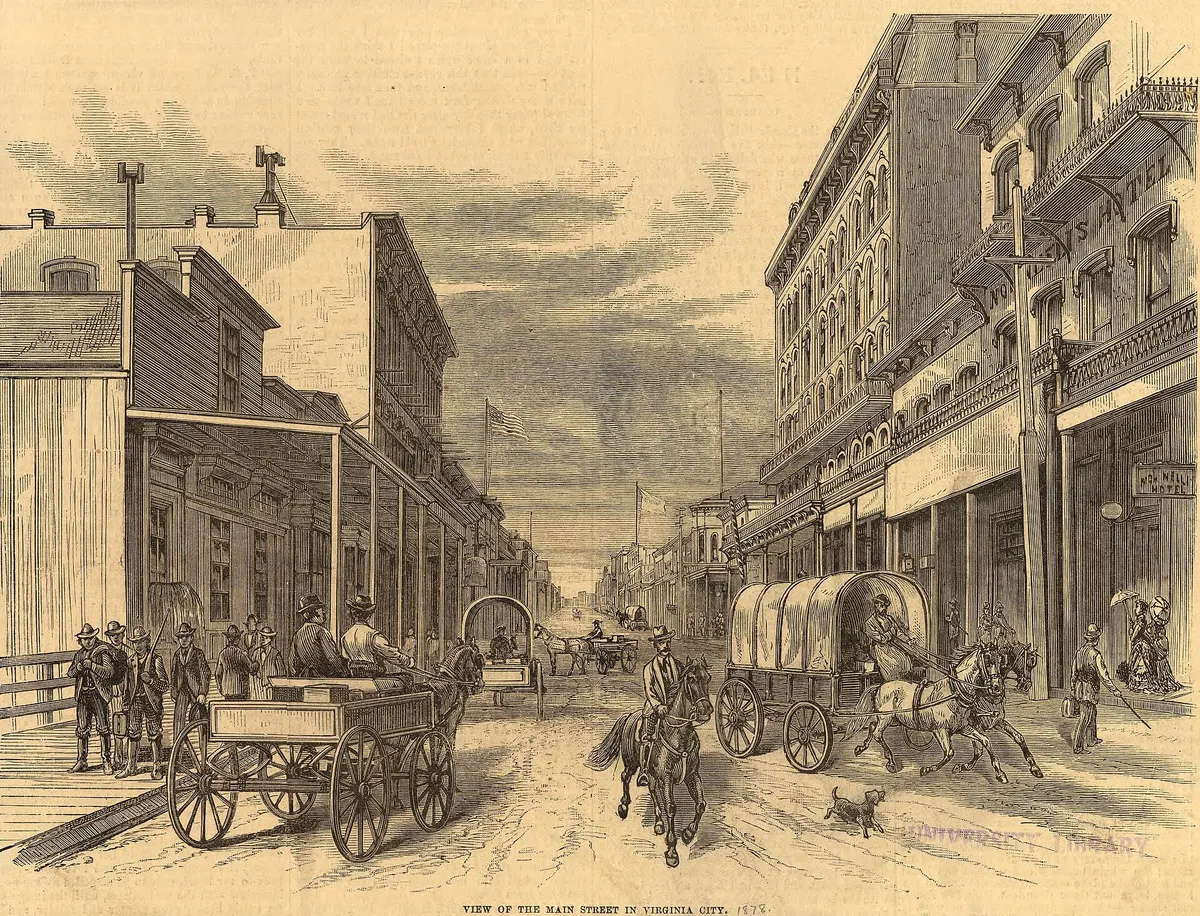
The news detonated one of the greatest mineral rushes in American history. Within months, thousands of prospectors poured over the Sierra Nevada from California, and the hillside above Gold Canyon erupted into Virginia City, a metropolis of extraordinary energy and pretension. At its peak in the early 1870s, Virginia City housed approximately 25,000 people, making it the largest and most important city between Chicago and San Francisco. It had opera houses, newspapers (the Territorial Enterprise, where Mark Twain honed his craft), stock exchanges, elaborate hotels, churches, and ethnic neighborhoods — all perched impossibly on the steep eastern slope of Mount Davidson at an elevation of over six thousand feet.
The Comstock Lode itself was mined through a series of major bonanzas — rich ore bodies discovered at intervals that revived the district each time it seemed to be exhausting itself. The Big Bonanza of 1873, discovered by the Irish–American partnership of John Mackay, James Fair, James Flood, and William O’Brien (the “Bonanza Kings”), was the greatest single strike in the district’s history, yielding more than $100 million in silver and gold over the following years. Total Comstock production through the end of the major mining era in the 1880s reached approximately $300–400 million, of which more than 8 million ounces was gold.
The decline of the Comstock was steep. By the late 1880s, the known ore bodies had been largely exhausted, the great mine shafts were filling with water, and the machinery of the industry — the mills, the railroads, the pumping engines — began to stand idle. Virginia City’s population collapsed to a few hundred. For a generation, northern Nevada seemed to have yielded its treasures and subsided.
The third chapter began at the dawn of the twentieth century. In 1900, prospector Jim Butler, searching for a lost mule in the desert of Nye County in central Nevada, picked up a heavy rock that proved to be extraordinarily rich silver-gold ore. His discovery at Tonopah inaugurated a new wave of Nevada mining that revived the state’s fortunes and demonstrated that its mineral wealth had not been exhausted. Tonopah’s success, followed almost immediately by the Goldfield gold discovery in 1902, set off a rush that drew capital and prospectors back to Nevada and revealed that the state’s ore potential extended far beyond the Comstock.
The final chapter was written in 1934. President Franklin Roosevelt’s executive order raising the official price of gold from $20.67 to $35 per ounce transformed the economics of marginal gold properties across the West. In northern Nevada, long-dormant mines on the Comstock and elsewhere became economically viable overnight, and companies initiated new exploration and development programs. The Arizona Comstock Company began underground mining through the Hale & Norcross tunnel in 1933, and the 1934 price increase accelerated this activity, sustaining Nevada gold production into the late 1930s. The 1934 date thus marks not the end of Nevada’s gold story — mining continues to this day, and Nevada remains the third-largest gold producer in the world — but the close of the eighty-four-year arc that began with those first placer pans in Gold Canyon.
Timeline
Gold rush begins
Rush concludes / mining activity winds down
Notable Figures
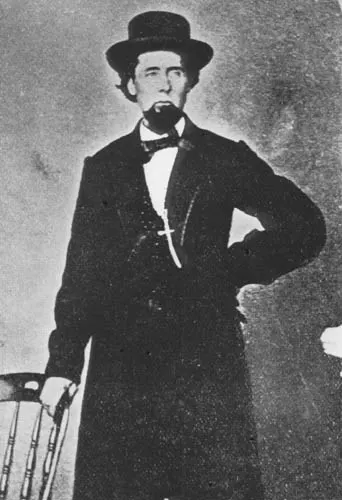
Henry Comstock
Notable FigureHenry 'Old Pancake' Comstock was a Canadian-born prospector who talked his way into a share of the 1859 silver discovery in Nevada's Six-Mile Canyon. The Comstock Lode, the richest silver deposit in American history, bears his name, though he died poor.
Jim Butler
Notable FigureJim Butler was a Nevada rancher and part-time prospector whose May 1900 discovery of silver-rich ore at Tonopah, famously credited to a wandering burro, set off the boom that revived Nevada mining and opened the state's twentieth-century bonanza era.
Nevada's mining story runs in two great waves. The 1859 Comstock Lode at Virginia City — silver laced with gold — created the first industrial mining metropolis in the West, financed San Francisco's rise, drove statehood in 1864, and pioneered deep-mining technology like square-set timbering. Its boom came at heavy cost to the Northern Paiute and Washoe peoples, whose piñon forests were felled for mine timbers and whose resistance flared in the 1860 Pyramid Lake War. A second wave began in 1900 at Tonopah and 1902 at Goldfield, reviving a moribund state economy and seeding modern Nevada mining, which today makes the state one of the world's top gold producers.
Virginia City is now a National Historic Landmark district of boardwalks, mine tours, and museums like the Fourth Ward School, while Tonopah's headframes stand preserved at the Tonopah Historic Mining Park. The Nevada State Museum in Carson City occupies the old US Mint that once coined Comstock silver.