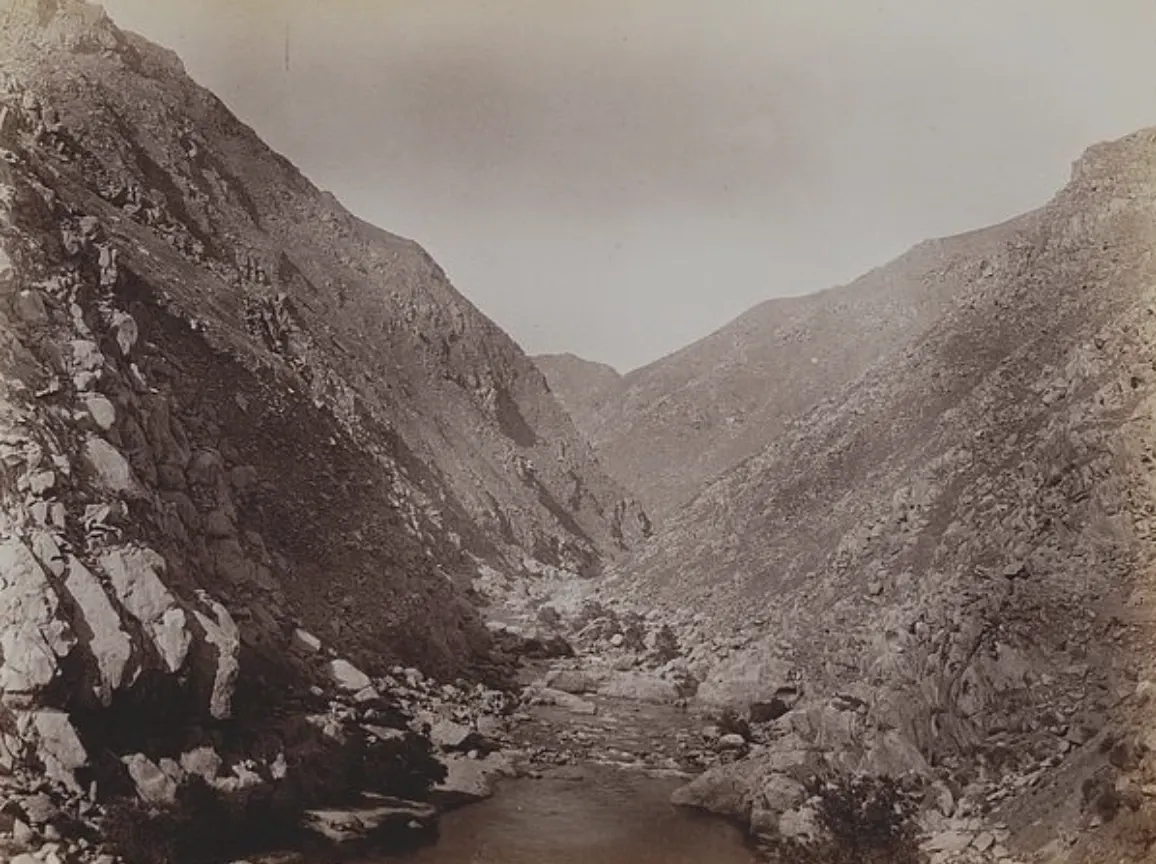
Kern River California Gold Rush
California, 1853–1858 (lode mining continued through 1870s)
Date range
1853 – 1858
Key Towns
Keyesville, Kernville (Whiskey Flat), Havilah, Quartzburg
Trigger Event
Gold was first noted in the Kern River watershed in 1851 near the Greenhorn Mountains. The rush proper began in 1853 when more substantial placer deposits were confirmed near Walker's Pass in the Kern River Valley, drawing prospectors south from the already-exhausted northern Sierra Nevada diggings.
Gold Recovered
Exact totals undocumented; Keyesville was the primary producing site from 1853–1870; the Big Blue Ledge at Kernville was a significant lode discovery. Production substantial but modest relative to northern CA rush.
Peak Population
Thousands of miners in the district at peak; Keyesville was the largest settlement and served as regional center through the 1860s
Map: Kern River California Gold Rush (35.49, -118.50)
The Kern River Gold Rush of 1853–1858 was one of the most significant secondary gold rushes in California's history, drawing thousands of prospectors to the rugged terrain of the southern Sierra Nevada in the years following the initial peak of the great 1848 California Gold Rush. While it never matched the scale or fame of the northern California rush, it opened up an entirely new region of the state, gave birth to a cluster of enduring frontier towns, and laid the economic foundation of what would become Kern County.
Gold had first been noticed in the Kern River watershed as early as 1851, when prospectors working the fringes of the California goldfields made preliminary finds near the Greenhorn Mountains. But it was in 1853 that the rush took shape in earnest, when more substantial deposits were confirmed near Walker's Pass in the Kern River Valley, drawing a concentrated wave of prospectors south from the already-crowded northern diggings. The timing was not coincidental: by the early 1850s, the richest placer deposits of the northern Sierra Nevada had been largely worked out, and miners were actively pushing south and east in search of fresh ground.
The first major focal point of the rush was the area around the South Fork of the Kern River, where prospectors found both placer gold in the stream gravels and gold-bearing quartz veins in the surrounding hillsides. The town of Keyesville was founded in 1853, named for Richard Keys, one of the first miners to establish a significant operation in the area. Keyesville quickly grew into the administrative and commercial center of the rush, supporting a mixed economy of placer and quartz mining. For more than a decade, it remained the most important settlement in the Kern River mining district.
The terrain of the southern Sierra Nevada presented challenges distinct from the northern goldfields. The Kern River canyon was steep, remote, and difficult to supply, and the region's relative distance from San Francisco and Sacramento meant that the logistical demands of sustaining large operations were considerably greater. Water, always essential for placer mining, was also harder to manage in the drier southern Sierra landscape, and miners were forced to develop increasingly elaborate diversion systems to direct creek flows across the gold-bearing gravels.
Despite these challenges, the rush produced a growing network of camps and settlements. Kernville — originally called Whiskey Flat, a name that speaks volumes about its early character — was established around 1860 when whiskey dealer Adam Hamilton relocated his operations to the banks of the main Kern River. The settlement grew around both the liquor trade and the nearby Big Blue Ledge, a rich gold-bearing vein discovered by a prospector known as 'Lovely' Rogers after he tracked a stray mule across the mountains from the earlier camp at Keyesville. Rogers' find demonstrated that the gold of the Kern River district was not confined to alluvial deposits but extended into deeper lode formations accessible only through hard-rock mining.
The transition from placer to lode mining that marked the maturation of the rush required new capital, new tools, and new expertise. The rough mining camps of the early years gave way to more permanent communities supported by stamp mills, assay offices, and the infrastructure of sustained industrial operation. Havilah, established after gold was found in the surrounding mountains later in the decade, eventually became the first county seat of Kern County and home to the region's first newspaper, the Havilah Courier, founded in 1866.
By the late 1850s, the most productive placer deposits along the Kern River had been largely worked out, and the rush's first phase drew to a close. Lode mining continued profitably for years thereafter — Keyesville remained active until 1870, and parts of the district saw further development well into the twentieth century — but the chaotic, rapid-settlement era of the gold rush had run its course. The towns, roads, and supply routes established during the rush created the foundational infrastructure of Kern County, one of California's most economically significant counties, and the prospectors who explored the southern Sierra Nevada documented the region's geography, water sources, and mountain passes in ways that proved invaluable to later settlers, railroad builders, and agricultural developers.
Timeline
Gold rush begins
Rush concludes / mining activity winds down
Notable Figures
Richard Keys
Notable FigureRichard Keys (also spelled Keyes) was a prospector whose 1853 gold discovery on the Kern River launched the Kern River gold rush in Southern California. The camp of Keysville, founded in 1854, and the Keys Mine both bear his name; little else about his life is recorded.
Lovely Rogers
Notable FigureLovely Rogers was a Kern River prospector who, while tracking a stray mule around 1860, discovered the Big Blue lode near present-day Kernville, California. His strike gave rise to the camps that grew into Kernville, though records of his own life are scant.
Gold found near Keyesville in 1853 drew thousands into the southern Sierra, and exaggerated reports set off the "Kern River fever" of 1855, when as many as 5,000 hopefuls rushed a district that could support only a fraction of them. Camps like Keyesville, Quartzburg, and Whiskey Flat (later Kernville) took root, and mining opened the Kern country to ranching and settlement. For the Tübatulabal and Kawaiisu peoples of the river valleys the rush brought catastrophe, culminating in the 1863 Keyesville Massacre, when soldiers and settlers killed dozens of Native men — part of the wider violence that devastated California's Indigenous nations.
Old Kernville and other sites now lie beneath or beside Lake Isabella, created in the 1950s, and the rebuilt Kernville is a whitewater and heritage tourism hub. The Kern Valley Museum tells the valley's mining and movie-location history, and the Keyesville area remains a designated recreational mining zone popular with hobby prospectors.