Clearwater Gold Rush
The Rocky Mountain West, 1860–1861
Date range
1860 – 1861
Key Towns
Pierce City, Oro Fino City, Orofino
Trigger Event
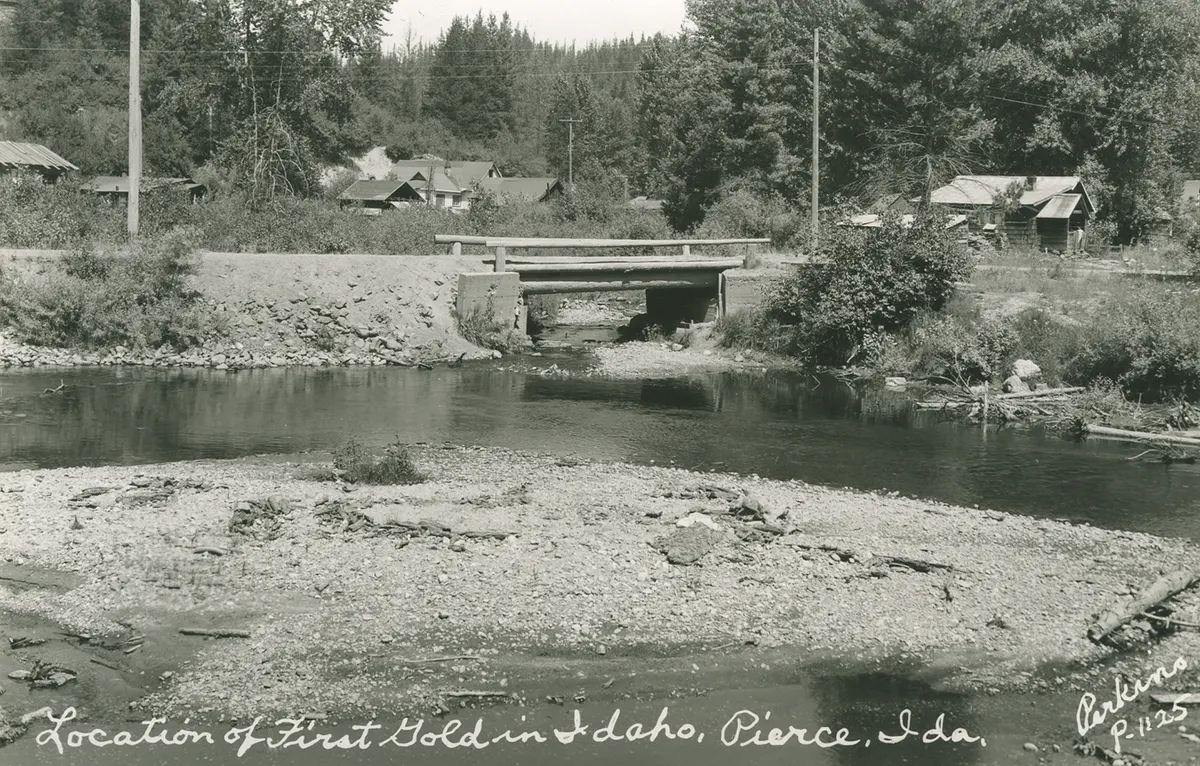
On September 30, 1860, Captain Elias Davidson Pierce and Seth Ferrel discovered placer gold on the North Fork of the Clearwater River near present-day Pierce, Idaho, on land protected by the 1855 Nez Perce treaty. A confirming strike by W.R. Bassett at Canal Gulch followed the next day, establishing the richness of the district.
Gold Recovered
Several million dollars from the Pierce district; total Clearwater drainage produced $23.8 million over all productive years
Peak Population
~6,000 individuals rushed to the Pierce district in 1861; first major influx of settlers into present-day Idaho
Map: Clearwater Gold Rush (46.48, -115.79)
The Clearwater Gold Rush of 1860 was the first significant gold rush in present-day Idaho, one of the most consequential mineral discoveries in the history of the Pacific Northwest, and the event that opened Idaho to large-scale Anglo-American settlement for the first time. It prompted the establishment of Idaho Territory in 1863 and set in motion a chain of subsequent rushes across the region that continued for decades.
The discovery was made by Captain Elias Davidson Pierce, a veteran Indian trader and persistent prospector who had long suspected the existence of gold in the Clearwater River watershed. Pierce had first visited the region during the 1850s while trading with the Nez Perce, who occupied the land under rights guaranteed by the 1855 Treaty of Walla Walla — a treaty that technically prohibited white settlement. An Indigenous man had reportedly told Pierce years earlier that gold lay in the area in such abundance it could be gathered by the handful, a claim he never forgot. In September 1860, Pierce led a party onto Nez Perce land and on September 30, he and companion Seth Ferrel found placer gold on the North Fork of the Clearwater River near present-day Pierce, Idaho. The next day, W.R. Bassett made a richer find at Canal Gulch, confirming that the district held genuine promise.
Pierce City and Oro Fino City — named for the Spanish term for fine gold — were established that winter, just two miles apart in the dense forests of north-central Idaho, marking the first permanent American settlements in the future state. The rush that followed in 1861 brought upwards of 6,000 individuals to the Pierce district, an enormous number for a remote mountain landscape accessible only by difficult trails through dense timber and broken terrain. Supply routes were cut through the forest, and a rudimentary economy of merchants, freighters, and service providers sprang up to support the miners.
The legal complications of the rush were significant from the start. The discovery was made on land guaranteed to the Nez Perce by treaty, and the influx of thousands of prospectors was a clear violation of that agreement. The federal government, unwilling to enforce treaty protections against a gold rush, moved instead to renegotiate — ultimately forcing a new treaty in 1863 that dramatically reduced the Nez Perce reservation and opened the goldfields to legal mining. This 1863 treaty, bitterly opposed by a faction of the Nez Perce and never recognized as legitimate by many band leaders, would contribute directly to the Nez Perce War of 1877.
The Clearwater drainage ultimately produced several million dollars in gold from the Pierce district alone, with total Clearwater drainage production reaching $23.8 million over the full span of productive years. The rush established the template for Idaho’s subsequent gold discoveries — the Boise Basin rush of 1862, the Owyhee rush of 1863, and others — and the infrastructure it created provided the primary argument for the creation of Idaho Territory in 1863. Pierce remains one of Idaho’s oldest towns, and the Clearwater National Forest preserves much of the landscape through which the original prospectors moved.
Timeline
Gold rush begins
Rush concludes / mining activity winds down
Notable Figures
Elias Davidson Pierce
Notable FigureElias Davidson Pierce was an American trader and prospector whose 1860 expedition onto Nez Perce lands found gold on Orofino Creek, the first discovery in what became Idaho. The rush that followed built the town of Pierce and opened the Clearwater mines.
Seth Ferrel
Notable FigureSeth Ferrel (also recorded as Ferrell) was an American prospector in Elias D. Pierce's 1860 party that slipped onto the Nez Perce reservation and found gold on Orofino Creek, the discovery that opened the Clearwater mines and founded Pierce, Idaho.
W.R. Bassett
Notable FigureW.R. Bassett, usually recorded as Wilbur F. Bassett, was the member of Elias D. Pierce's 1860 party credited with panning the first gold in Canal Gulch on Orofino Creek, the founding discovery of the Idaho goldfields.
Elias D. Pierce's 1860 strike on Orofino Creek — made while trespassing on the Nez Perce reservation — set off Idaho's first gold rush. Thousands poured into camps like Pierce, Oro Fino, and Elk City, and the boom drove the creation of Idaho Territory in 1863. The cost fell heavily on the Nimiipuu (Nez Perce): the same year, federal negotiators forced through the so-called "steal treaty," slashing the reservation by about ninety percent to legalize the miners' occupation, a betrayal that fed directly into the Nez Perce War of 1877.
The placers faded within a few years, but Pierce survives as Idaho's oldest incorporated town, its 1862 courthouse the state's oldest public building. Chinese miners reworked the district for decades, a history remembered along with the tragic 1885 hanging of five Chinese miners. The Clearwater Historical Museum in Orofino and local heritage sites interpret the rush and its aftermath.